Courage and determination
Silver Coin
When Maria Theresa ascended the throne at the age of just 23, she was unprepared for the role of ruler - yet not in the least intimidated by the magnitude of the task. From the very beginning, she faced her many opponents with determination.
This coin marks the launch of our anniversary series celebrating the 300th birthday of the Empress. All coins in the series are based on medals that were struck during Maria Theresa’s lifetime.
Our series: historically aware and beautifully crafted.
It’s a girl!
On 13 May 1717, Maria Theresa was born as the elder of two daughters of Emperor Charles VI. It soon became clear what a strong and remarkable personality was growing up at the Viennese court. With the unexpected death of her father in 1740, the Habsburg dynasty in the male line came to an end. At just 23 years old and pregnant for the fourth time, Maria Theresa ascended to power.
But what situation did she face? Empty state coffers, an impoverished and skeptical population, timid advisers—and a young woman confronted with the challenge of holding together an empire whose widely scattered provinces aroused the ambitions of neighboring powers. Half of Europe sought to take advantage of the presumed power vacuum in Vienna. Moreover, it had never pleased her father to prepare her for her role as sovereign; in defending her vast inheritance, she could rely on no prior experience or training. Just two months after Charles’s death, King Frederick II of Prussia made the first move and invaded the then Habsburg province of Silesia. But a power vacuum and Maria Theresa? No, those do not go together. Brave and resolute, she set to work.
The Coin
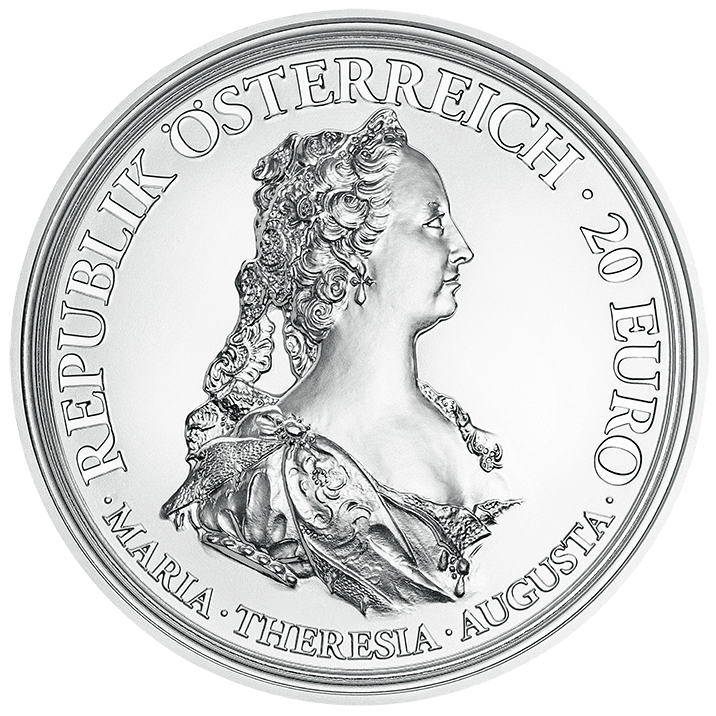
The coin depicts a bust of the young Maria Theresa with the inscription “Maria Theresia Augusta” —“Maria Theresa, the Queen.” The coin image is based on a relief by the medallist Matthäus Donner dating from 1741.
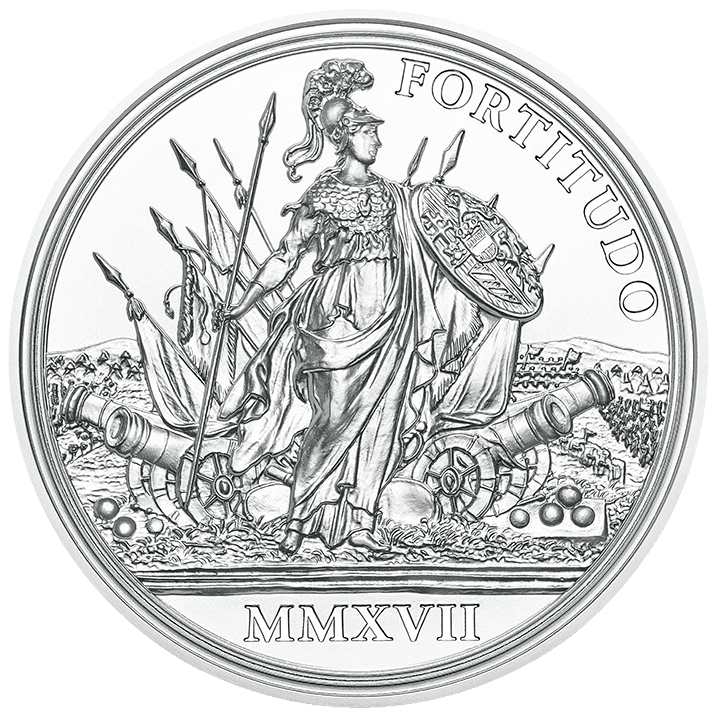
On the reverse, two relief elements from historical medals are combined into a single motif. The main image shows the Queen in the guise of the armed Minerva. The inscription “Fortitudo” —“Courage”—appears on the upper right edge of the coin.
“Courage and Determination” is the first coin in the series “Maria Theresa – Treasures of History.”
| Issue Date | 18 April 2017 |
| Quality | Polierte Platte / Proof |
| Series | Maria Theresia – Schätze der Geschichte |
| Denomination | 20 Euro |
| Engravers | Mag. Helmut Andexlinger, Herbert Wähner |
| Diameter | 34,00 mm |
| Alloy | Silver Ag 925 |
| Fine Weight | 20,74 g / 0,66 oz |
| Total Weight | 22,42 g |
Justice and Severity
Silver Coin
With this coin - modeled on medals commissioned by Maria Theresa - we draw attention to the empress’s unique ability to fulfill three roles at once: those of wife, mother, and sole ruler. The reward for this multitasking was the enjoyment of power. She loved to rule, and she loved what she ruled over.
By Order of Her Majesty
Maria Theresa and Francis I: Their harmonious appearance side by side on the coin was more than mere illusion. In fact, the young Maria Theresa had imagined him as her husband; theirs was a love match. At first, she wished for Francis to rule jointly with her and to be admired by all. Eventually, however, she had to realize that he was not equal to the task. Gently, she eased him aside—hardly against him, but rather against herself; her deep affection for him nevertheless remained unchanged.
From then on, she intended to share power with no one. Tirelessly, she sought to resolve the contradictions arising from the triple burden of being a wife, a mother, and a professional ruler, striving to follow both heart and mind. In this, she resembles in many ways the woman of today.
The Coin
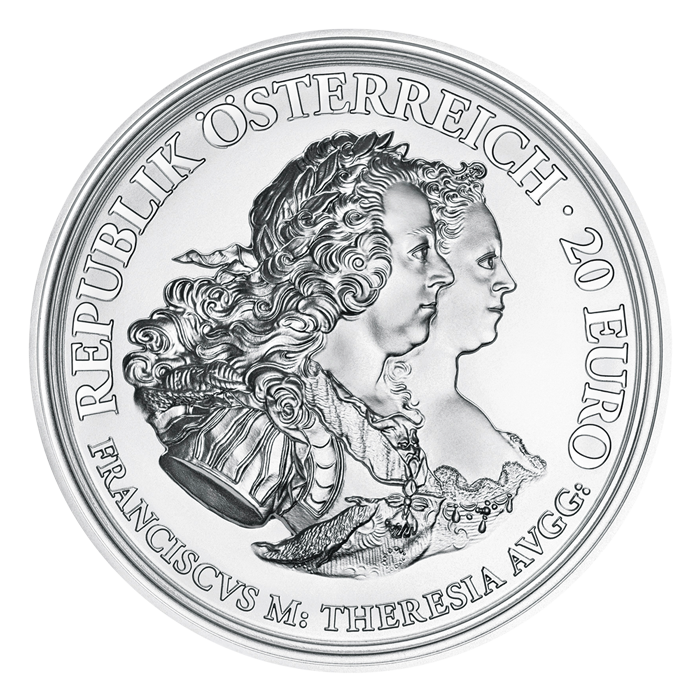
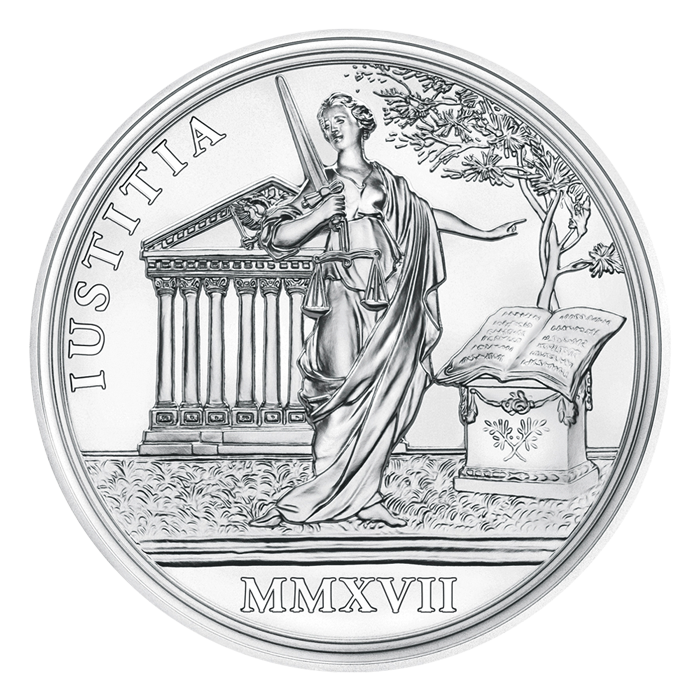
The obverse shows a bust of Maria Theresa together with her husband, Francis I, based on a model by Anton Wiedemann (1724–1792). On the reverse, several elements from historical medals are combined into a single motif. In the foreground stands the goddess of justice.
The striking three-dimensional effect is due to the high relief, as was customary in the art of minting during the Empress’s era.
A special coin in honor of a remarkable woman
| Issue Date | 21. November 2017 |
| Quality | Polierte Platte / Proof |
| Series | Maria Theresia – Schätze der Geschichte |
| Denomination | 20 Euro |
| Engravers | Mag. Helmut Andexlinger, Herbert Wähner |
| Diameter | 34,00 mm |
| Alloy | Silber Ag 925 |
| Fine Weight | 20,74 g / 0,66 oz |
| Total Weight | 22,42 g |
| Scope of Delivery | Presented in a case with a numbered certificate and slipcase. |
Wisdom and Reforms
Silver Coin
The fourth - and final - coin commemorating 300 years of Maria Theresa completes the portrait of the monarch and rounds off the series. Like all the previous issues, this coin is based on medal designs from Maria Theresa’s era and features an unusually high relief.
A newly minted silver coin - almost a Habsburg heirloom.
Mother and Son
After the death of her husband, Maria Theresa once again shared her power; cooperation with Joseph II would prove to be extremely complex. The Queen, who had always regarded herself as a ruler by the grace of God, saw her legacy threatened by her enlightened son. Mother and son were too different in their worldviews, yet too similar in their will to power.
Out of fear of losing authority, but also out of maternal concern, she never ceased to demand obedience from him. Maria Theresa viewed her son with both suspicion and pride at the same time. Yet neither of them wished for the other’s withdrawal. What made their cooperation so difficult was the unfortunate mixture of deep mistrust and profound affection. Mother and son could neither rule together nor do without one another.
The Coin
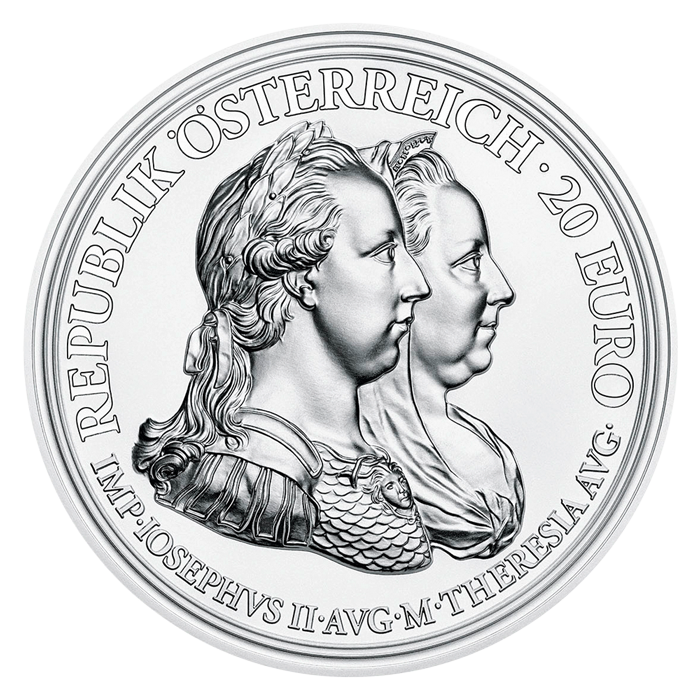
The value side depicts a bust of Maria Theresa with her son Joseph II in the foreground. The inscription reads “IMP IOSEPHVS II AVG M THERESIA AVG” (“Imperator Josephus II Augustus, Maria Theresa Augusta”). The coin image is based on a historical model signed F. Würth F.
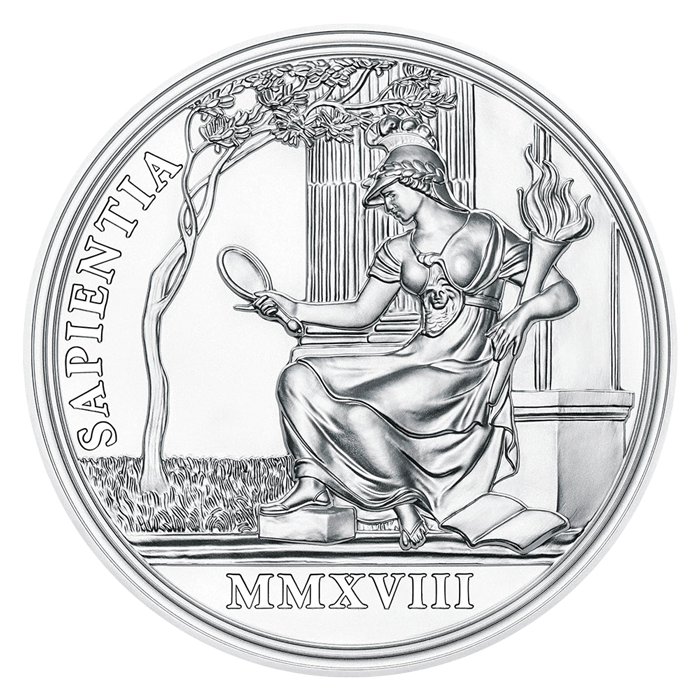
On the reverse, several elements from historical medals are combined into a single motif. The allegorical representation of Wisdom, in the form of a female figure, appears on the right half of the coin, with the inscription “Sapientia” (Wisdom) on the left rim.
The series “Maria Theresa – Treasures of History” presents Austria’s most important ruler in all her facets.
| Issue Date | 3. Oktober 2018 |
| Quality | Polierte Platte / Proof |
| Series | Maria Theresia – Schätze der Geschichte |
| Denomination | 20 Euro |
| Diameter | 34,00 mm |
| Alloy | Silber Ag 925 |
| Fine Weight | 20,74 g / 0,66 oz |
| Total Weight | 22,42 g |
| Scope of Supply | Presented in a case with a numbered certificate, slipcase |
Clemency and Trust in God
Silver Coin
This coin, also part of our anniversary series celebrating 300 years of Maria Theresa, is designed based on motifs from the time of the monarch and produced in the style customary at the time. It is distinguished by an exceptionally high relief.
With “Clemency and Faith in God,” another historical image shines in new splendor.
Her Darkest Hour
In August 1765, Maria Theresa and her husband Francis Stephen were staying in Innsbruck on the occasion of the marriage of their son Leopold to Maria Ludovica of Bourbon. After fourteen days, the celebrations came to an abrupt end. “... and so the good Emperor, within a quarter of an hour—from half past nine to a quarter to ten—was healthy, alive, and dead,” records a chronicle by Gottfried Pusch, referring to the unexpected death of Francis Stephen on 18 August.
Maria Theresa spent several days in the greatest solitude, immersed in prayer. Preserving the memory of her husband became a central purpose of her life; she cultivated a true culture of mourning. She had the Emperor’s death chamber in the Innsbruck Hofburg converted into a chapel. The black widow’s attire she donned the day after her beloved’s death remained her clothing until her own passing.
The Coin
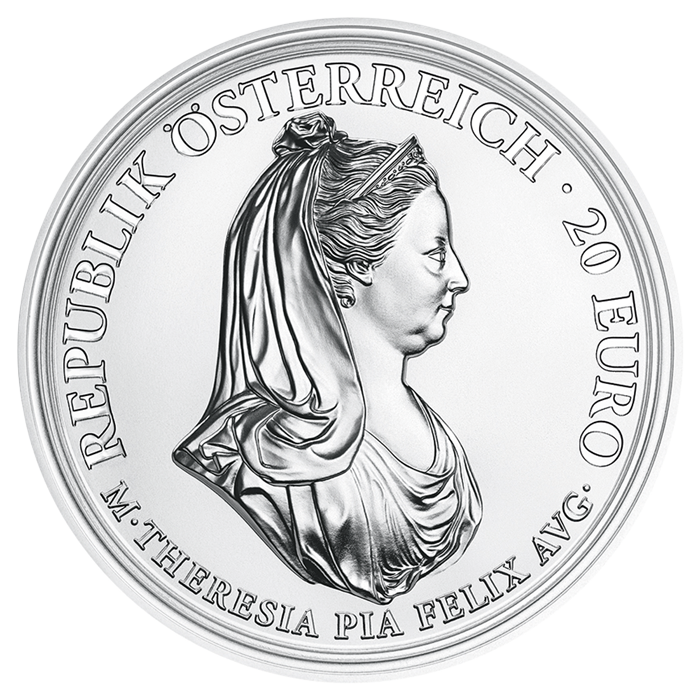
The value side shows a bust of Maria Theresa. The inscription reads “M THERESIA PIA FELIX AVG” (“Maria Theresa, pious and fortunate ruler”). The coin image is based on a historical relief by the medallist Anton Guillemard (1747–1812).
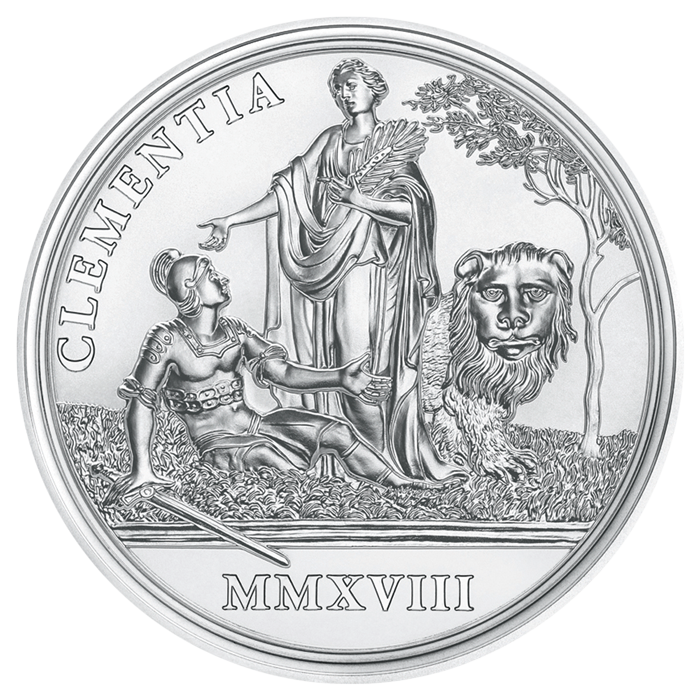
On the reverse, several elements from historical medals are combined into a single motif. At the center appears an allegory of Clemency: a female figure holding a palm branch in her left hand. She extends her hand to a defeated soldier lying at her feet. To her right is a tamed lion. The inscription “Clementia” (“Clemency”) appears on the left rim of the coin.
The four‑part series “Maria Theresa – Treasures of History”: historically informed and beautifully crafted.
| Date of Issue | 25. April 2018 |
| Quality | Polierte Platte / Proof |
| Series | Maria Theresia – Schätze der Geschichte |
| Denomination | 20 Euro |
| Engravers | Mag. Helmut Andexlinger, Herbert Wähner |
| Diameter | 34,00 mm |
| Alloy | Silber Ag 925 |
| Fine Weight | 20,74 g / 0,66 oz |
| Total Weight | 22,42 g |
| Scope of Supply | Presented in a case with a numbered certificate and slipcase. |
Maria Theresa Thaler – Proof
Restrike
Version in a coin capsule for the Sammelmappe "Maria Theresia – Schätze der Geschichte"
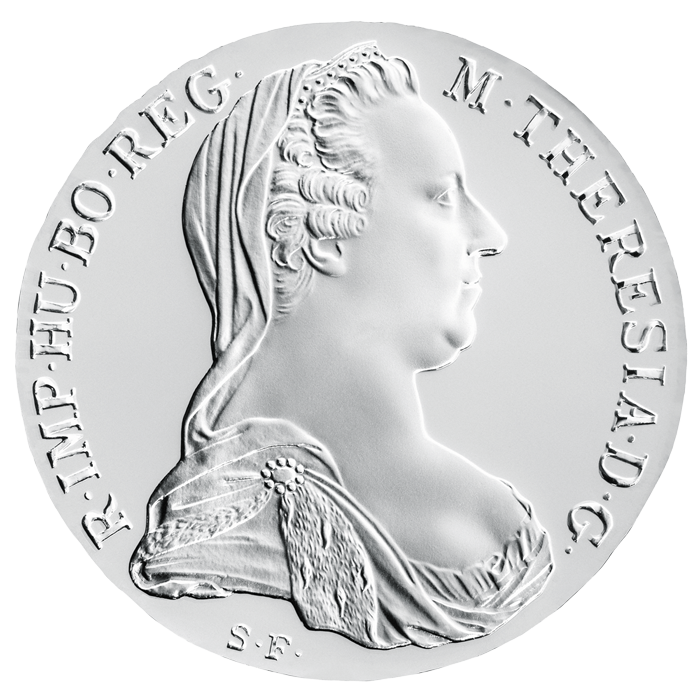
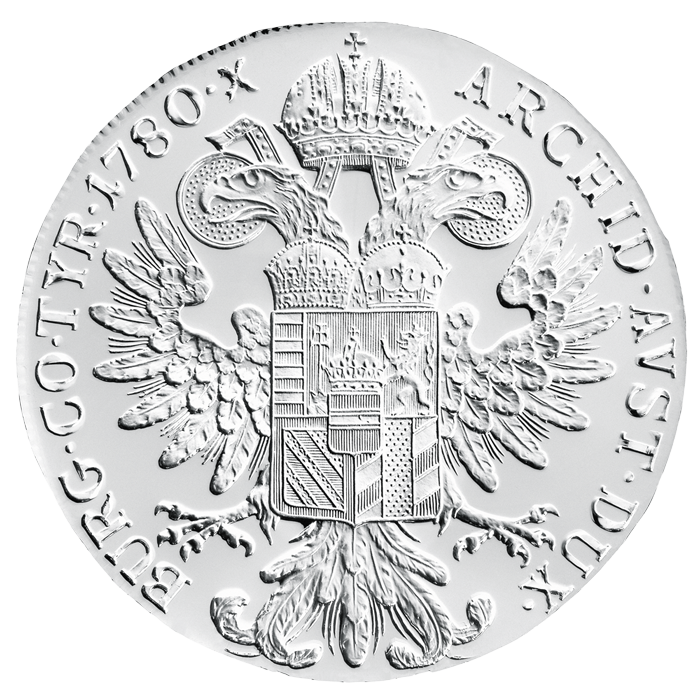
The Maria Theresa thaler is regarded as the most famous silver coin in the world. The first thaler was minted in 1741 and changed its appearance several times in the years that followed. Since 1780, it has been struck in the same design and bears this very year. The Maria Theresa thaler remained legal tender in Austria until 1858.
The coin features the famous portrait of the Empress wearing a widow’s veil, and on the reverse—alongside the double‑headed eagle, the imperial crown, and the coat of arms in circular inscription—is Maria Theresa’s motto: “Justitia et Clementia” , Latin for “Justice and Clemency.” The thaler was minted at various mints within the Holy Roman Empire and the Habsburg territories, as well as abroad, for example in Bombay (now Mumbai). As a historic piece of immense international significance, the Maria Theresa thaler is highly valued worldwide and is still minted today by the Austrian Mint (Münze Österreich AG).
| Date of Issue | 19. April 2017 |
| Quality | Polierte Platte / Proof |
| Series | Maria Theresia – Schätze der Geschichte |
| Diameter | 42,00 mm |
| Alloy | Silber Ag 833,3 |
| Fine Weight | 23,39 g |
| Total Weight | 28,07 g |
| Scope of Supply | In a coin capsule |